
Table of Contents
You are starting a business. You have heard you need liability protection. But now you see two confusing options.
LLC. And PLLC.
They look almost identical. They are not.
The choice between a PLLC vs LLC can save your personal assets or leave you exposed. Pick wrong, and your professional license could be at risk.
Let me break down exactly what you need to know before you file those formation papers.
What Is an LLC? The Simple Explanation

An LLC stands for Limited Liability Company.
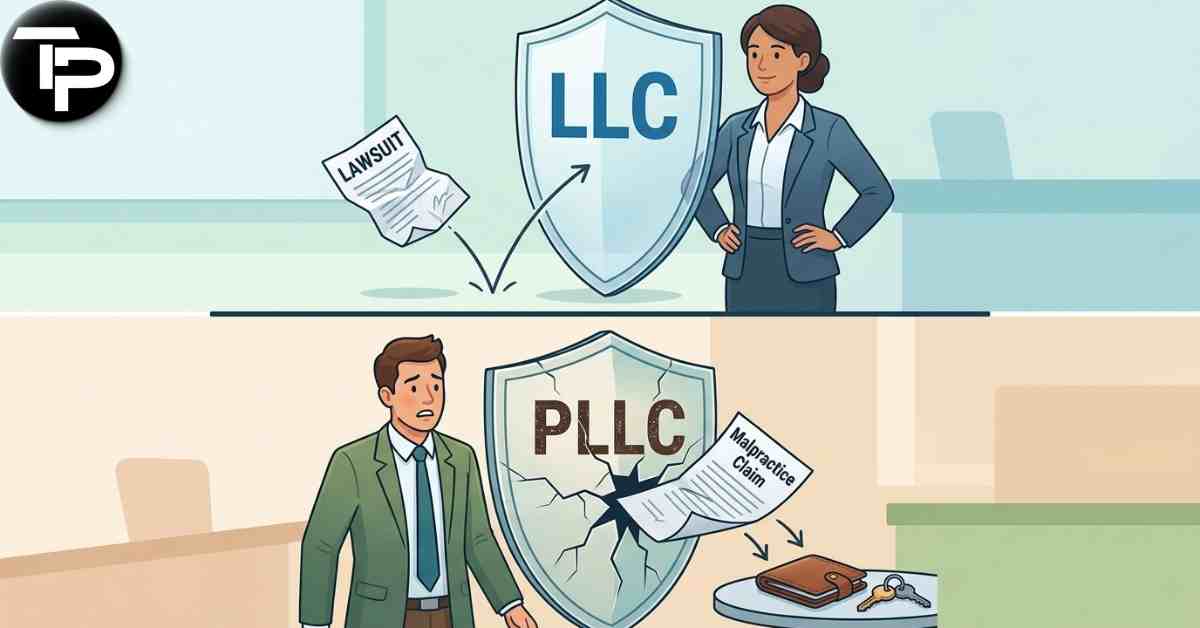
It is a legal structure that separates your personal money from your business debts. Someone sues your company. They cannot take your house, your car, or your savings.
That is the basic promise of an LLC.
Who Should Form an LLC
Any general business can form an LLC. Retail stores. Marketing agencies. Construction companies. Ecommerce brands.
You do not need a state license to do your job. That is the key.
If your work does not require a professional credential, an LLC is usually your best choice.
What Is a PLLC? Breaking Down the Meaning

Let me answer the first question most people ask.
What does PLLC stand for?
Professional Limited Liability Company.
The “Professional” part changes everything. A PLLC is specifically for licensed professionals. Doctors. Lawyers. Architects. Accountants. Therapists. Engineers.
These states require licensed professionals to form a PLLC instead of a standard LLC. They want to make sure you cannot hide behind a corporate shield if you mess up someone’s health or money.
PLLC Meaning in Plain English
The PLLC meaning comes down to one concept: personal accountability.
You still get liability protection for normal business debts. Rent. Vendor bills. Employee payroll.
But you cannot shield yourself from your own professional negligence. A patient sues you for medical malpractice. A client sues you for bad legal advice. That lawsuit can touch your personal assets in ways an LLC would block.
That is the trade-off.
PLLC vs LLC: The Five Critical Differences

Now let us get into the real LLC vs PLLC comparison. These differences matter.
Difference 1 — Who Can Form One
An LLC is for everyone. A PLLC is only for state-licensed professionals.
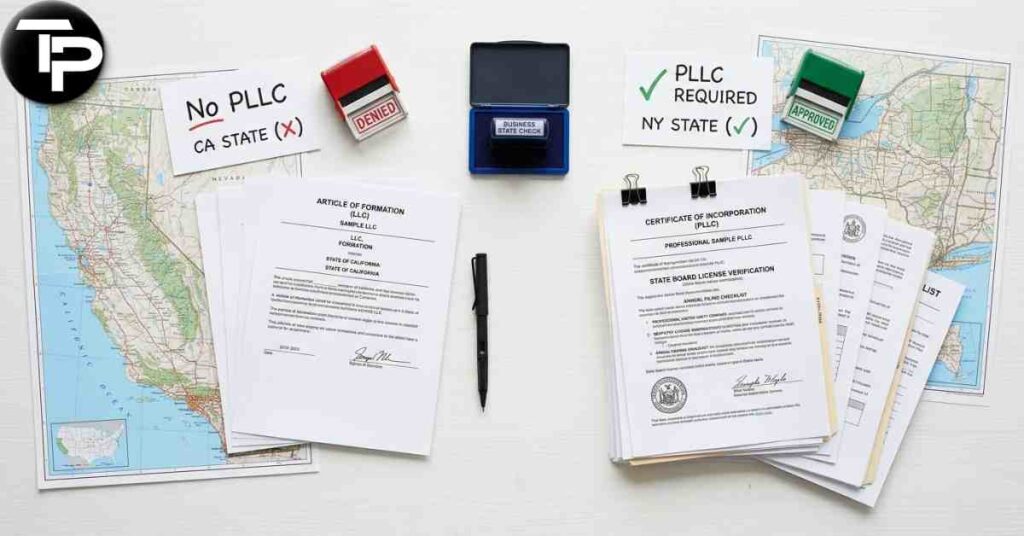
If you are a freelance graphic designer, you cannot form a PLLC. Your state will reject your application. You need an LLC.
If you are a dentist, you must form a PLLC in most states. Check your specific state laws before filing.
Difference 2 — Personal Liability for Negligence
This is the biggest difference when comparing what is a PLLC vs LLC.
An LLC protects you from your own negligence in most states. A PLLC does not.
Example. You own a marketing LLC and give bad advice. The client loses money. They sue you personally. The LLC structure often protects your personal house.
Same scenario but you are a therapist with a PLLC. A patient says your treatment caused harm. They can come after your personal savings. The PLLC does not block professional malpractice claims.
Difference 3 — State Availability
Every state allows LLCs.
Not every state allows PLLCs. California, for example, does not recognize PLLCs. Licensed professionals there must form professional corporations instead.
New York allows PLLCs but has strict ownership rules. Only licensed professionals can own shares. No outside investors.
Difference 4 — Formation Paperwork
LLC formation is standard across most states. File Articles of Organization. Pay a fee. Done.
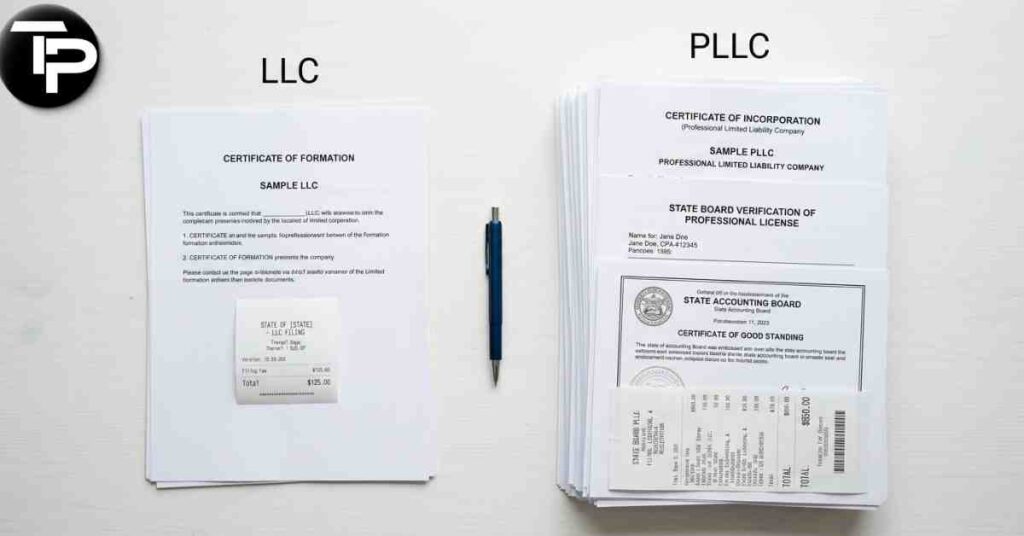
PLLC formation requires extra steps. You must prove your professional license is active and in good standing. Some states require a “Certificate of Good Standing” from your licensing board. This adds time and money.
Difference 5 — Name Requirements
LLCs can use any name that is not already taken. “Smith Consulting LLC” works fine.
PLLCs must include an indicator of the profession in most states. “Smith Dental PLLC” or “Jones Law PLLC.” The name tells the public exactly what service you provide.
Which Professions Absolutely Need a PLLC
Let me give you a clear list. You likely need a PLLC if you hold any of these licenses:
- Medical doctor (MD or DO)
- Dentist (DDS or DMD)
- Lawyer or attorney
- Certified public accountant (CPA)
- Architect
- Professional engineer (PE)
- Veterinarian
- Licensed therapist or psychologist
- Pharmacist
- Optometrist
If your profession requires a state board to issue a license, check your state laws before forming an LLC.
The Pharmacy and Medical Example
A standard LLC for a medical practice is a disaster waiting to happen.
You get sued for malpractice. Your LLC offers zero protection for that claim. The plaintiff’s lawyer goes straight for your personal assets. Your home. Your investments. Your children’s college fund.
A PLLC at least warns you about this exposure. It does not fix it. But you go in with open eyes and buy proper malpractice insurance.
When an LLC Is Actually Better Than a PLLC

Not every professional needs a PLLC.
Here is a pro tip. Some licensed professionals can operate under a standard LLC if they do not personally deliver the licensed service.
Example. You are a CPA but you own a bookkeeping business. Your employees do all the licensed work. You only manage. Some states allow an LLC in this scenario.
Another example. You are a licensed architect but you only do project management. You never stamp drawings. An LLC might work.
Check with a local business attorney before assuming you need a PLLC.
The Single Owner Advantage
If you are a solo practitioner with no employees, the difference between a PLLC and LLC matters less for daily operations.
Both protect you from business debts. Both require separate business bank accounts. Both file taxes the same way — as a sole proprietorship or S-Corp.
The only real difference is malpractice exposure. And that is what insurance is for.
Tax Treatment: No Difference at All
Here is where the PLLC vs LLC debate gets simple.
The IRS does not care which one you choose.
Both are taxed exactly the same way. By default, both are pass-through entities. Business profits go to your personal tax return. You pay self-employment tax on those earnings.
Both can elect S-Corp status to save on self-employment tax. Both can elect C-Corp status if that makes sense for your situation.
Do not make your decision based on taxes. Make it based on liability and state law.
Cost Differences Between PLLC and LLC
PLLCs are almost always more expensive. Here is why.
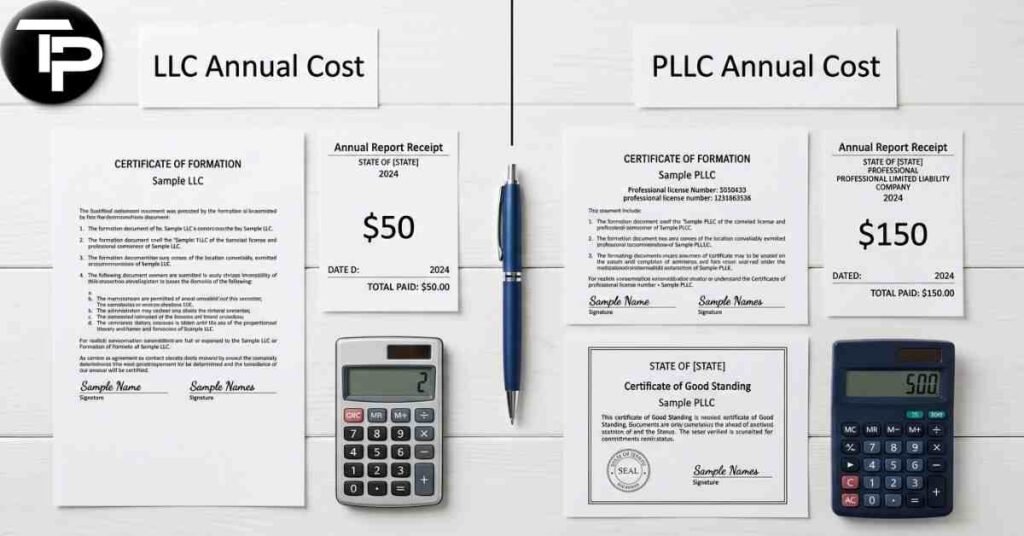
Standard LLC filing fees range from $50 to $500 depending on your state. PLLC fees are often $100 to $200 higher. You pay for the extra paperwork and licensing verification.
Annual report fees also trend higher for PLLCs in some states. New York charges $9 for LLC biennial statements. PLLCs pay $50 to $100 more for similar filings.
Plus you may need to pay your licensing board for that Certificate of Good Standing. Another $25 to $100 every time you file.
The Hidden Ongoing Cost
Malpractice insurance is not optional for PLLC owners.
An LLC owner selling t-shirts online does not need professional liability coverage. A PLLC dentist absolutely does.
That insurance costs $500 to $5,000 per year depending on your profession. Factor that into your decision.
How to Choose Between PLLC and LLC
Ask yourself three questions.
First question. Does my state require a PLLC for my profession? Look up your state’s business formation website. If yes, you have no choice. Form the PLLC.
Second question. Do I have a state professional license? If yes, a PLLC is safer even if not required. Some states let licensed pros choose. Choosing an LLC can look like you are hiding something.
Third question. Will I ever commit professional negligence? Hopefully not. But if the answer is “maybe,” a PLLC at least forces you to carry proper insurance.
Frequently Asked Questions
What is a PLLC vs LLC in simple terms?
An LLC is for general businesses. A PLLC is for licensed professionals like doctors, lawyers, and accountants. The main difference is that a PLLC does not protect you from your own professional malpractice.
What does PLLC stand for in a business name?
PLLC stands for Professional Limited Liability Company. You will see it after business names like “Smith Medical PLLC” or “Jones Law PLLC.” It tells the public that licensed professionals own and operate the business.
Can I convert my LLC to a PLLC later?
Yes, in most states. You file amended Articles of Organization and provide proof of your professional license. Some states require you to dissolve the LLC and form a new PLLC from scratch. Check with your Secretary of State office.
Do I need a PLLC if I have malpractice insurance?
You still need the correct legal structure. Malpractice insurance covers claims. The PLLC determines whether those claims can reach your personal assets. Many states require the PLLC regardless of your insurance status.
Which is cheaper to maintain, LLC or PLLC?
An LLC is cheaper. Lower formation fees. Lower annual report fees. No requirement to prove license status every year. No mandatory malpractice insurance. If you do not need a PLLC, do not pay for one.
Make Your Choice and Move Forward
The PLLC vs LLC decision is not as hard as it seems. Most business owners want a standard LLC — it is cheaper, simpler, and offers broader protection. But if you hold a professional license, check your state laws first. Many states remove the choice entirely. You must form a PLLC. No exceptions. And here is the honest truth — a PLLC does not protect you from malpractice lawsuits. Nothing does except good insurance and excellent work. Talk to a local business attorney for thirty minutes. Spend the $200 on advice. Then file the correct structure the first time. Fixing it later costs ten times more.